
Did the war change the name of my street?
The burden of occupations and wars
The publication of the book on place names in Brussels (Les noms des lieux à Bruxelles - EUB) gives us an opportunity to revisit this issue and its implications in the context of the two world wars.
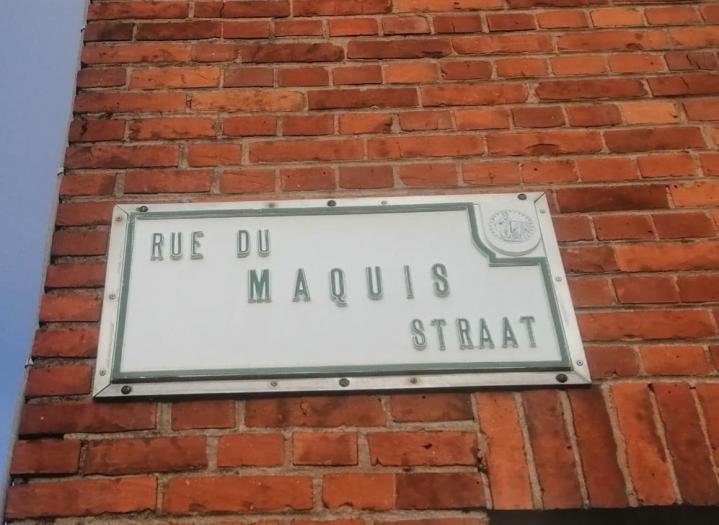
Did you know, for example, that the municipality of Evere was the first to rename its Cyriel Verschaeve Street? The decision was made by the municipal council as early as September 21, 1944. At the same time, Ernest Claes Street was also renamed.
The new names were chosen with care: Maquis Street for the former and Resistance Street for the latter. We should also note the decision taken by the Brussels City Council to rename Avenue du Midi as Avenue de Stalingrad in July 1945, and not in 1948 as stated on an explanatory sign installed on-site in 2012. In reality, the City wanted to pay tribute to Marshal Stalin, but the municipality of Woluwe-Saint-Lambert had beaten it to the punch. In fact, in November 1944, the municipality—led by a liberal/socialist majority—decided to rename Place de Finlande, a name dating back to January 1940, and transform it into Place Maréchal Staline. This was by no means an unlikely location but rather the square where the Town Hall stands, now known as Place Tomberg. At the time, Woluwe-Saint-Lambert was not yet as urbanized as it is today, and the surroundings were rather rural. Arriving as a scout, the Soviet ambassador found the location unworthy of the “Little Father of the Peoples” … Marshal Stalin Square would therefore never come into being, but in the meantime, since the City of Brussels had been unable to pay tribute to the Soviet leader, it settled instead… on the martyred city of Stalingrad!
The avenue was officially inaugurated in the presence of the Soviet ambassador in December 1945. On this occasion, the mayor of Brussels, the liberal Joseph Vandemeulebroeck, praised Stalin in glowing terms: “Our admiration for their brilliant leader knows no bounds, and we will never forget him.” To this day, none of the attempts to rename the avenue have been successful.
These two examples remind us that place names are important markers of our landscape. The two world wars played a major role in shaping them. While the number of streets in the capital that directly honor the memory of World War I is far higher than those dedicated to World War II—263 for the former and 182 for the latter— it is simply because these changes occurred mainly in the interwar period, at a time when the capital underwent impressive urban and demographic development requiring the creation of numerous new thoroughfares.
When we examine the changes brought about by the two world wars, it is, of course, primarily the postwar periods that we scrutinize. However, it is undoubtedly worth noting that during the conflicts themselves, this issue was very much present. Thus, during World War I, the municipalities of Brussels once again addressed the sensitive issue of duplicate street names. And during the second occupation, Secretary General Gerard Romsée sought to take advantage of the circumstances to tighten the conditions for name changes, challenge recent renamings, and revert to names steeped in tradition. While his plans certainly did not have time to come to fruition, they left their mark on the legislative front, making the process of name changes more difficult.
Online Resources
The issue of place-name nomenclature in Brussels has been the subject of a series of lectures titled “Nom d’une rue” organized by the Royal Academy of Belgium. These lectures can be viewed on the Academy’s YouTube channel (Académie royale de Belgique - YouTube).
In addition, the database containing 5,099 unique street names is now online (OdonIris - EBxl). Besides a set of freely downloadable maps, users can also access, via the Zenodo platform, an Excel file containing the data used to establish the categories and subcategories—and thus also the maps (see file odoniris_V2.csv). The tool is subject to improvement and evolution. Through a dedicated tab, each user can submit suggestions for changes by citing the appropriate sources. The database can thereby be improved through a participatory process.
Finally, the publication 'Les noms de lieux à Bruxelles. Enjeux passés et présents' is now available in French and Dutch. The French version will also soon be accessible online on the platform Les noms des lieux à Bruxelles - EUB. The Dutch version is already available on the platform Brusselse plaatsnamen | Leuven University Press.