
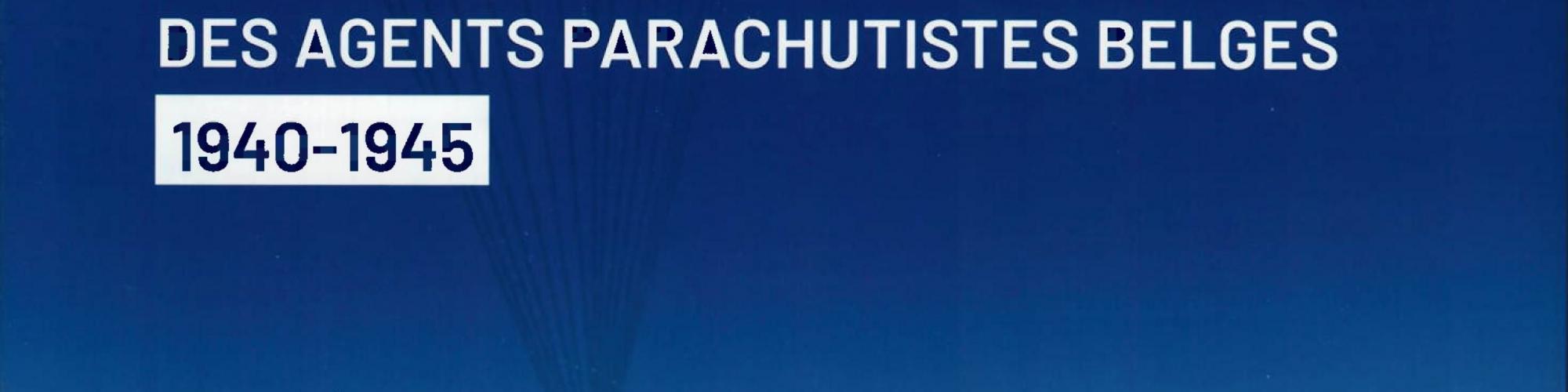
La guerre secrète des agents parachutistes belges 1940-1945
The CegeSoma and the non-profit organisation Friends of the CegeSoma invited Marie Marchand, Jean-Claude Maréchal and Peter Verstraeten on 25 March 2026 for the presentation of their book, La guerre secrète des agents parachutistes belges 1940–1945. Fabrice Maerten spoke with two of the three authors present about the behind-the-scenes aspects of their investigation, the itineraries of the agents, and the historic issues revealed by this extraordinary work. Both an homage to these Belgian resistance fighters and an essential reference work, the book sheds new light on the resistance in Belgium and the secret war waged from London.
Commissioned by the British, Belgian, and American secret services operating from London, 333 Belgian agents (or people working for the Belgian services) were parachuted into or infiltrated across the continent from June 1940 to May 1945 (and, in the case of a few missions, even later). Their objectives were to gather intelligence; circulate propaganda; carry out acts of sabotage; liaise between local resistance organisations and the Allies; facilitate the escape of airmen and resistance fighters to the United Kingdom; and provide financial and material support to resistance organisations and those fleeing forced labour in Germany. Their actions informed Allied strategy and contributed significantly to the liberation of Europe.
The fruit of in-depth research conducted in Belgian, British, American and German archives, this book is based, in particular, on the analysis of hundreds of personnel files held at the British National Archives (Kew, London), the Belgian National Archives, and the Belgian Military Archives in Evere, as well as. the mention the rich collections of the SOE and the Belgian State Security Service held at the CegeSoma. Once collected and organised, data from these files can be used to reconstruct each agent's background and profession, their escape from Belgium, their connection to the services, their training in Great Britain, their mission(s) and their subsequent fate.
The book is divided into two main sections. The first covers the context and structures, namely the British and Belgian services and how they worked together; agent training; risks from German law enforcement; the role of escape networks; special ops; and even services set up after the Liberation. Part two discusses the missions carried out in a chronological order, placing them in the broader context of the war, major international events, and the actions of the Belgian government in exile in London.
Marie Marchand is a retired internal medicine physician. In 2015, she joined the Fraternelle des Agents Parachutistes, of which her father, Georges Marchand (1911–1990), was a member.
Since 2017, she has been working with Jean-Claude Maréchal and Peter Verstraeten researching the history of these special agents.
Jean-Claude Maréchal is the godson of Charles Hoyez, who parachuted from London in March 1944 to join the leader of the Secret Army, but who disappeared in Germany a year later. After studying Germanic philology at the University of Liège, he worked as a teacher, then as a translator for the European Communities, and finally as an attaché in economic affairs.
He is the author of the biography Charles Hoyez: Un Agent parachutiste dans l’Histoire (EME 2016).
Fabrice Maerten is a doctor of history from UCLouvain who devotes most of his research to the history of the Resistance in Belgium during World War II.
In charge of guiding the public through the CegeSoma collections, he coordinates the online platform ‘Resistance in Belgium’ and is the author of Papy était-il un héros ? Sur les traces des hommes et des femmes dans la Résistance pendant la Seconde Guerre mondiale (2020).