
The FED-tWIN BEMULTILAT Project
Opening Diplomatic Archives to Researchers and the Public
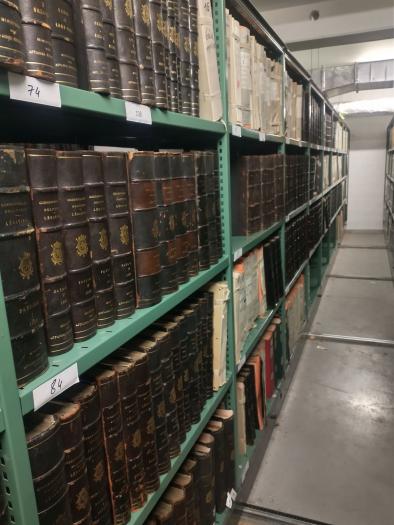
As a reminder, the FED-tWIN BEMULTILAT project began in 2023. It is led by Vincent Genin within a dual institutional framework: CegeSoma/State Archives, under Michael Auwers, and the University of Liège, under Catherine Lanneau. The project aims to highlight, utilize, and make accessible the Diplomatic Archives (just over 6 linear kilometers) held by the Belgian FPS Foreign Affairs, Foreign Trade, and Development Cooperation, which are scheduled to be transferred to the State Archives. Combining archival work, basic research, teaching, and public history, this project focuses specifically on the issue of multilateralism.
Background
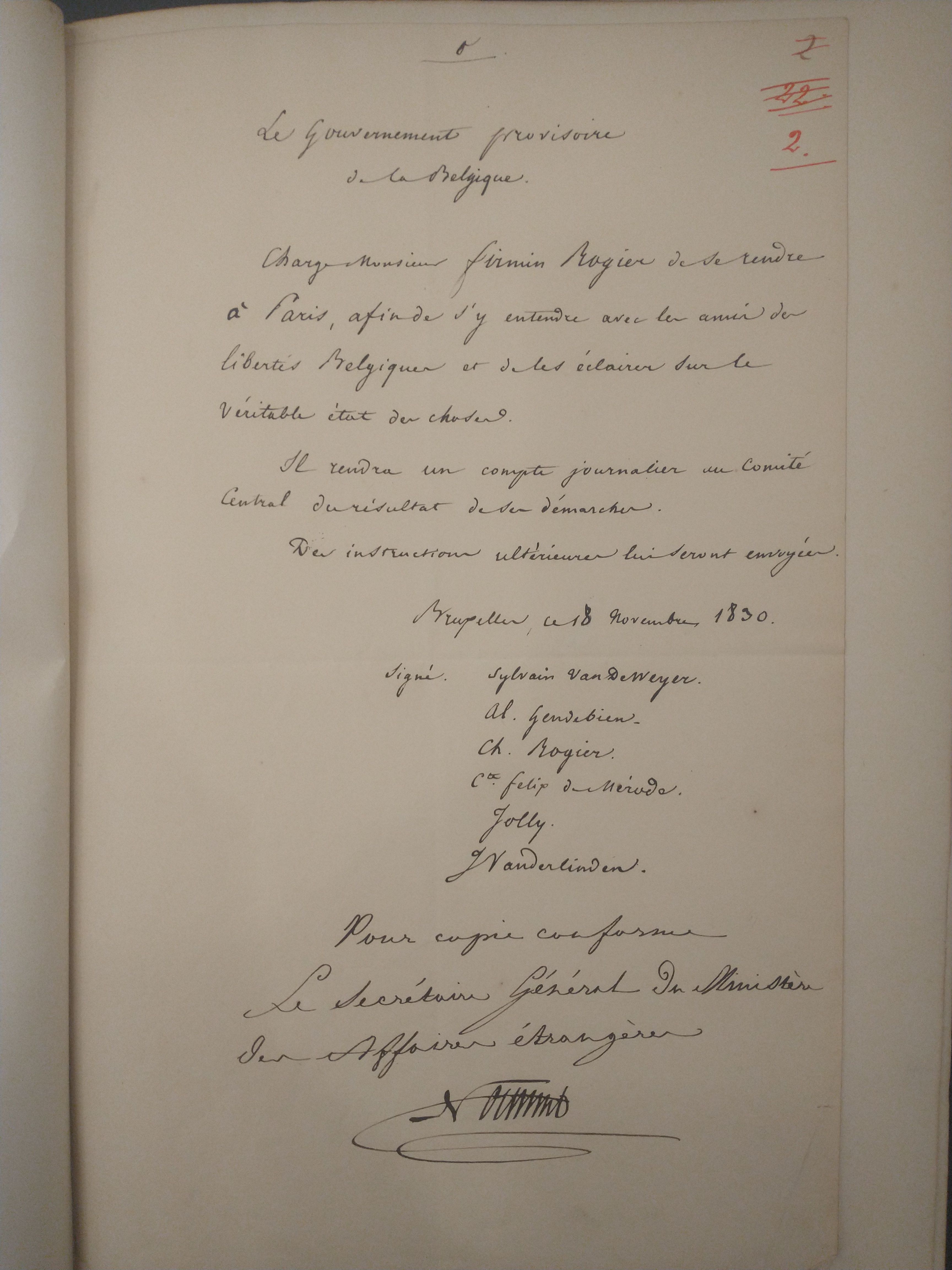
the Ministry of Foreign Affairs, November 18, 1830, SPFAE.
Since independence in 1830, Belgium has been part of the existing international order. A small, open economy in the 19th century and a country with permanent, perpetual, and guaranteed neutrality, it had to carve out a place for itself among the Great Powers, up until World War I and the 1919 Versailles Peace Conference. At that conference, it was relegated to the rank of countries with “special interests.” No longer neutral (until 1936) and now a member of the League of Nations, it entered a major international arena in Geneva within the framework of collective security.
Although a small country—and at times an arbitrator in international disputes—it nevertheless contributed significantly to this multilateralism through some of its representatives, such as Paul Hymans (League of Nations), Ernest Mahaim (ILO), Camille Gutt (IMF), Fernand Dehousse (Universal Declaration of Human Rights), Paul-Henri Spaak (NATO, UN, European institutions), and Michel Hansenne (ILO).
Today, Belgium is a member (or observer) of most existing multilateral organizations (IAEA, Benelux, IBRD, CERN, UNCTAD, CPA, ICC, FAO, ILO, WHO, NATO, UN, etc.).
Diplomatic archives are thus a gold mine. Until recently, no inventory of these collections was available, and access to these sources was long considered, at best, discretionary—if not legally questionable. Thanks to a marked improvement in the situation, there is now a gradual shift toward greater openness regarding these archives.
Achievements
Several scholarly articles have already been written as part of this project, examining Belgium’s role in multilateralism based on sources preserved by the Diplomatic Archives:
- « Une historiographie née sous le signe de l’hétéronomie. Des memoranda de Banning au programme scientifique de Michel Huisman (1863-1953) », in Revue Belge de Philologie et d’Histoire, 101, 2025, p. 873-888.
- « Maintenir l’anglais hors-pouvoir. Une réaction américaine à Versailles (1924) », in Guido Braun, Renaud Meltz, Camille Desenclos (dir.), Langues et diplomaties (du XVe siècle à nos jours), Stuttgart, Kolhammer, 2024, p. 241-253.
- « Émile Banning (1836-1898), de Liège à la conception de la politique étrangère belge », in Revue d’Histoire Liégeoise, IV, 2024, p. 73-87.
- « L’article 18 de la Déclaration Universelle des Droits de l’Homme de 1948. Temporalités des droits de l’homme et liberté religieuse », in Revue d’histoire ecclésiastique. Louvain Journal of Church History, vol. 119, 1-2, 2024, p. 158-193.
The FRS-FNRS Contact Group “Belgium and Contemporary Worlds” organized a first study day on November 22, 2024, at CegeSoma on the theme “International Relations and Emotions.” On April 17, 2026, a second symposium was held at the University of Liège, chaired by Professor Michel Dumoulin, with the assistance of Professor Catherine Lanneau (ULiège), on “Multilateralism: Methodological Issues and the Belgian Case (19th–21st Centuries).” Of particular note were the quality of the discussions and the ability to create synergies among researchers in the history of contemporary international relations from Liège, Louvain-la-Neuve, and Luxembourg. A publication is expected to follow, and a two-day international conference will be organized by the end of 2027.
Since 2024, oral interviews have been conducted with archivists from the FPS Foreign Affairs to ensure the “transfer of expertise” and “experience” emphasized by this project.At the University of Liège, since the 2024–2025 academic year, these aspects of the project have been fully integrated in the course on the History of Belgium’s International Relations, and students are encouraged to write master’s theses that draw on the Diplomatic Archives. During the 2025–2026 academic year, a research seminar also focused on the Belgian delegation to the 1919 Versailles Peace Conference.
The project’s findings were also shared with a wider audience, notably through the radio program “Un jour dans l’histoire” on La Première channel : an interview about Aristide Briand in May 2026 and another about Paul-Henri Spaak in June 2026.
New Perspectives
A special issue of Jalon de recherches focusing on the Diplomatic Archives will soon be published. Its aim is to provide a historical, archival, and legislative overview of the sources held by the ministry. It will be followed by a more comprehensive Guide to Sources.
From September 2 to 6, 2026, Vincent Genin will participate in the international symposium in Bern. There, he will present the edition of the Belgian Diplomatic Documents relating to the CSCE (1968–1975).
The edition of the correspondence between the historian Théodore Juste and the diplomat and politician Jean-Baptiste Nothomb is scheduled to appear in the Bulletin de la Commission royale d’histoire.Remarkable archival documents representative of Belgian diplomatic activity over nearly two centuries are scheduled to be exhibited at the end of the year at the State Archives in Liège and at the University of Liège.